
Drought Status Update
The Commonwealth of Massachusetts requires water use restrictions in times of declared drought. See the following restrictions that are in place at this time. Failure to follow drought restrictions can lead to fines. Drought status is updated monthly.
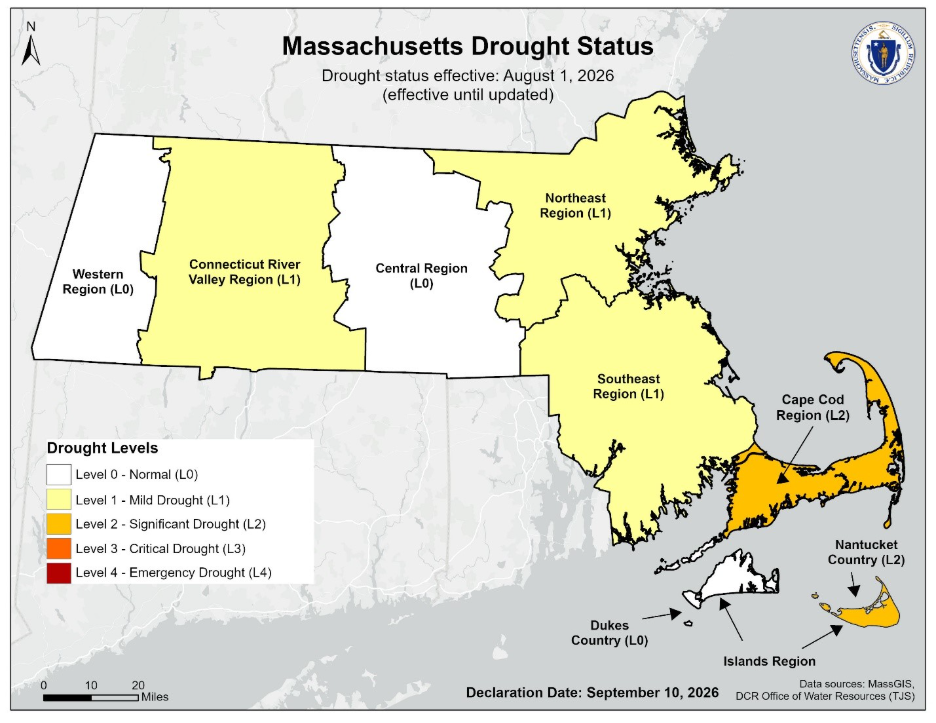
Sunderland, as part of the Connecticut River Valley Region, is experiencing Level 1 - Mild Drought* (updated September 10th). This represents a bettering drought condition from the previous month. Until conditions return to normal some steps must be followed to minimize water use. These restrictions are state required:
Level 1 (Mild Drought): All nonessential outdoor water uses are restricted to no more than one day per week, before 9 a.m. and after 5 p.m., except that watering of ornamentals and flower gardens with drip irrigation, hand-held house or watering cans may be permitted.
Level 2 (Significant Drought): All nonessential outdoor water uses are banned, except that watering of ornamentals and flower gardens with drip irrigation, hand-hold hose or watering cans may be permitted.
Level 3 (Critical Drought) or Level 4 (Drought Emergency): All nonessential outdoor water uses are banned.
*Drought conditions are an assessment of conditions over time, including the previous month’s precipitation, streamflow, and groundwater conditions, and are not predictive like a weather forecast.
Nonessential Outdoor Water Use means a use that is NOT required: The following are deemed essential uses and not banned.
For health or safety reasons, including public facilities used for cooling such as splash pads and swimming pools, and for washing of boats, engines, or marine equipment to prevent negative saltwater impacts or the transfer of invasive aquatic species.
By permit, license, statute or regulation.
For the production of food, including vegetable gardens, and fiber.
For the maintenance of livestock.
To meet the core functions (those functions essential to the commercial operations) of a business, including but not limited to:
Plant nurseries as necessary to maintain stock.
Golf courses as necessary to maintain greens and tees, and limited fairway watering per 310 CMR 36.07(2)(c)2. a. through c.
Venues used for weddings or similar special events that limit watering to hand-held hose or drip irrigation as necessary to maintain gardens, flowers and ornamental plants.
Professional washing of exterior building surfaces, parking lots, driveways and/or sidewalks as necessary to apply surface treatments such as paint, preservatives, stucco, pavement, or cement in the course of construction, reconstruction or renovation work.
For irrigation of public parks before 9:00 a.m. and after 5:00 p.m.
For irrigation of public and private recreation fields, including those operated by schools, colleges, universities, and athletic associations, before 9:00 a.m. and after 5:00 p.m.
For irrigation of publicly-funded shade trees and trees in the public right-of-way.
To establish a new lawn as necessary to stabilize soil in response to new construction or following the repair or replacement of a Title 5 system.
Examples of nonessential outdoor water uses include:
Irrigation of lawns.
Washing of vehicles other than by means of a commercial car wash, except as necessary for operator safety.
Washing of exterior building surfaces, parking lots, driveways or sidewalks, except as necessary to apply paint, preservatives, stucco, pavement or cement.
Frequently Asked Questions: Drought Related
If drought restrictions are mandated by the state, why aren’t all towns proclaiming the same restrictions?
Water suppliers want to sell water; restrictions are enacted to meet state regulations and protect the ability to provide water into the future.
There are many reasons why restrictions will be different in neighboring towns. The foremost is that the state authorizes the use of surface and ground water sources for drinking water through various legal mechanisms, which are not themselves consistent in their response to state declared drought. That is, they follow different rules. The second is that towns and water districts can enact additional restrictions to protect their system and ensure adequate water supply. Additionally, drought severity can be declared by region, county, or watershed, resulting in tighter restrictions in adjacent towns.
What are the penalties for violating restrictions?
The District’s bylaws lay out the following penalties: $50.00 for the first violation, and $100.00 for the second and subsequent violations. Each separate issuance of a citation shall constitute a separate violation.
Where can I learn more about drought status?
You can find additional information about Drought Status at the state webpage https://www.mass.gov/info-details/drought-status.